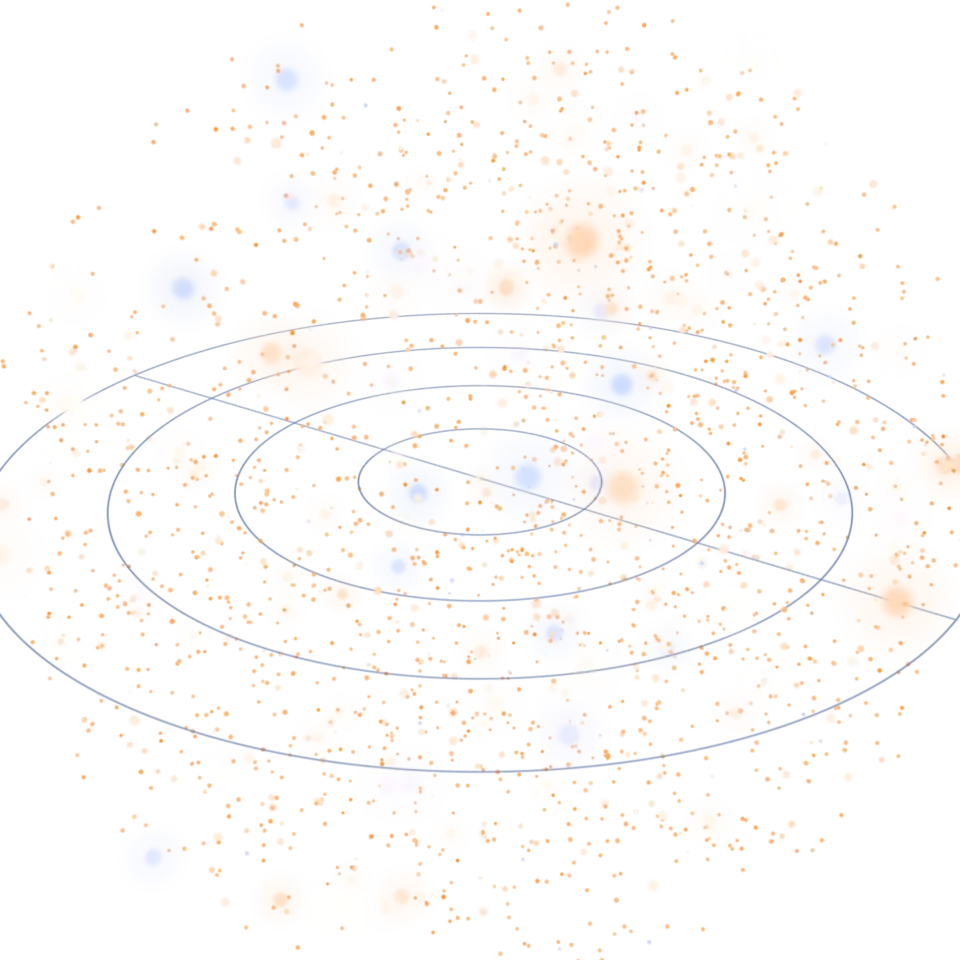
Every star within about 65 light-years (20 parsecs) of the Sun, where it really is: about 2,200 stars measured by ESA's Gaia spacecraft, from the tiny shift of each star's position as Earth goes round the Sun.
- Shelf
- Space
- Kind
- Built from a recipe
- Made from
- Stars within 65 light-years of the Sun, where Gaia measured them; the brightest few, which Gaia cannot measure, from Hipparcos. Colors from their temperatures; sizes show brightness, not the stars' real sizes.
- Sound
- Yes
- Licenses
- CC BY-SA 3.0 IGO, CC BY-SA 4.0
How to play
Tap to fly to Alpha Centauri, Sirius, Barnard's Star, Vega or Arcturus and back.
Its controls
| Control | Kind | Range | Start |
|---|---|---|---|
| Fly to the next star and back | Tap | ||
| Fly to a star | Button | ||
| Star sizes | List | 2 choices | By brightness |
About it
Every star within about 65 light-years (20 parsecs) of the Sun, where it really is: about 2,200 stars measured by ESA's Gaia spacecraft, from the tiny shift of each star's position as Earth goes round the Sun. About 35 of the brightest, which Gaia cannot measure, like Sirius and Vega, come from the older Hipparcos survey (via the HYG database).
The Sun is in the middle; the faint rings lie in our Galaxy's plane, and the line points to its center. Each star's color comes from its temperature: red dwarfs, the most common stars, are orange-red; hot stars are blue-white. The sizes show brightness, not size. Tap to fly to a named star and see its distance; the first is Alpha Centauri, with Proxima Centauri, the nearest star of all, beside it.
Is it right?
Every star within 20 parsecs (65 light-years) of the Sun that Gaia measured, plus the brightest few Gaia cannot measure, at its measured place in the Galaxy's frame, colored by the temperature its measured color implies. Sizes show brightness, not size, and say so.
Correct
The stars are the Gaia Catalogue of Nearby Stars within 20 pc, at their Galactic x, y and z.1
tools/sp2-stars.mjs reads GCNS from CDS VizieR (the median of each star's distance) and keeps every star closer than 20 pc.
Correct
Proxima Centauri is 4.25 light-years away, Barnard's Star 5.96, Sirius 8.6, Vega 25 and Arcturus 36.7.2
The test reads each named star's place from the data file and checks its distance.
Correct
Gaia cannot measure the brightest stars, so those brighter than magnitude 3.5 that GCNS lacks come from Hipparcos through the HYG database.3
tools/sp2-stars.mjs adds HYG stars within 20 pc brighter than 3.5 with no GCNS star within 0.15 pc; HYG also names the GCNS stars it shares.
Close
A star's color follows its temperature, from its measured color.4
Temperatures interpolated from Gaia's BP − RP (or B − V for HYG stars) along Mamajek's table of mean dwarf colors; each temperature is drawn as a blackbody's color.
- 1The Gaia Catalogue of Nearby Stars (Gaia Collaboration, Smart et al. 2021), Astronomy & Astrophysics 649, A6; CDS VizieR J/A+A/649/A6
- 2Proxima Centauri, Wikipedia
- 3HYG database v4.4, David Nash (astronexus), Codeberg
- 4A Modern Mean Dwarf Stellar Color and Effective Temperature Sequence, E. Mamajek (Pecaut & Mamajek 2013), version 2022.04.16
- Simplified
- Sizes show brightness (absolute magnitude), not the stars' real sizes; every star would be far smaller than a dot at this scale.
- Simplified
- Double and triple stars that Gaia did not separate are one splat.
- Simplified
- The rings mark the Galaxy's plane round the Sun; the line points to the Galaxy's center.
Sources and credits
| Work | By | License |
|---|---|---|
| Gaia Catalogue of Nearby Stars (Gaia Collaboration, Smart et al. 2021, A&A 649, A6) | ESA/Gaia/DPAC | CC BY-SA 3.0 IGO |
| HYG database v4.4 | David Nash (astronexus) | CC BY-SA 4.0 |