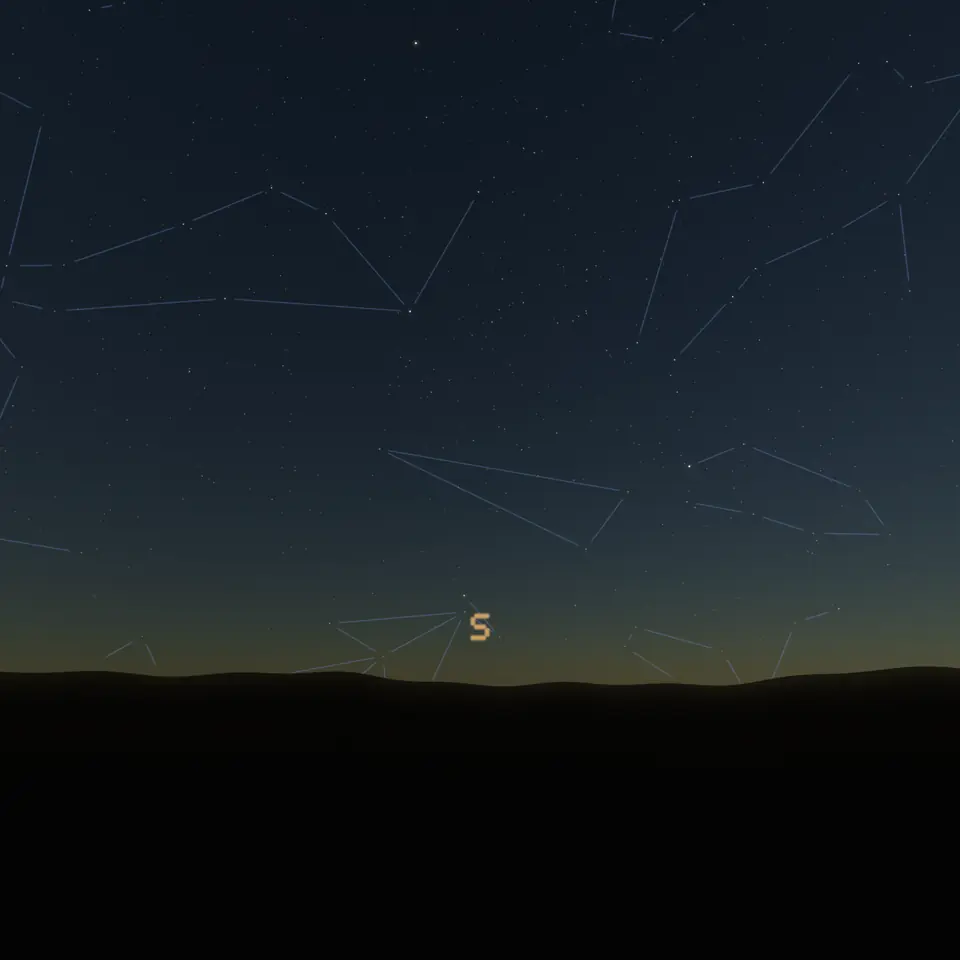
5, each a sharp point whose brightness follows its magnitude and whose color follows its temperature, and the Milky Way from the Gaia spacecraft's map of the sky.
- Shelf
- Space
- Kind
- Built from a recipe
- Your own
- The sky over…
- Sound
- Yes
- Licenses
- CC BY-SA 4.0, Facts, CC BY-SA 3.0 IGO, Public domain
How to play
Drag to look around the sky. Tap a star or a planet to name it.
Its controls
| Control | Kind | Range | Start |
|---|---|---|---|
| Name a star | Tap | ||
| Constellation lines | Switch | On | |
| Name it | Button |
About it
The sky over a place at a moment, as a camera at a dark place would see it: about 26,000 stars down to magnitude 7.5, each a sharp point whose brightness follows its magnitude and whose color follows its temperature, and the Milky Way from the Gaia spacecraft's map of the sky. The air's own light follows from where the Sun and the Moon are: blue by day, a sunset's and twilight's colors, the Earth's shadow, a faint glow along the horizon at night, and a paler sky under a bright Moon. Stars come out in twilight brightest first, and dim and redden near the horizon. The Sun, the Moon and the planets are placed by JPL's formulas for their orbits, and the Moon, from NASA's map, is lit from the Sun's side, so you see its real phase.
Pick a city in the Splash tab, type a latitude and longitude, or tap “Use my location” (your browser asks first; the place stays on your device). Set a date from 1800 to 2050, or speed time up to watch the sky turn. Sizes are real, with one exception: zoomed out, the Moon and the Sun are drawn at least 12 and 8 pixels across so you can see them (on a phone the Moon is then about two and a half times its real size, the Sun under twice); zoom in and they grow to their true size. The planets are points of light, since their discs are smaller than a pixel.
Is it right?
The sky over a chosen place and moment: about 5,000 cataloged stars, the Sun, the Moon with its phase, and the seven planets, placed by published formulas. Positions match JPL Horizons and Astropy to within a few hundredths of a degree for the Sun, the stars and the inner planets, about 0.2 degrees for Jupiter and Saturn and 0.3 degrees for the Moon. The sky's glow, the Milky Way's band and the drawn sizes of the Sun and the Moon are pictures, not measurements.
Close
The stars are where the HYG catalog puts them, turned for the place's sidereal time and the date's precession.12
Each star sits at its catalog J2000 direction. One rotation turns them all: precession to the date (Meeus 21.2, the IAU 1976 angles), then the place's local sidereal time and latitude.
Correct
Greenwich sidereal time follows the IAU 1982 formula.2
GMST = 280.46061837 + 360.98564736629 (JD − 2451545) + 0.000387933 T² − T³ / 38710000 degrees, plus the east longitude for local sidereal time.
Close
The planets and the Sun are placed by JPL's Keplerian elements for 1800 to 2050.34
Table 1's elements and rates give each orbit for the date; Kepler's equation gives the heliocentric position in the J2000 ecliptic; the Earth-Moon barycenter's position is subtracted, the planet's light-time allowed for, and the result turned to the equator.
Close
The Moon is placed by the Astronomical Almanac's low-precision series and corrected for where you stand.54
The series gives the Moon's ecliptic longitude, latitude and parallax for the date; the observer's place on the Earth (in Earth radii) is subtracted, which moves the Moon by up to a degree.
Correct
The Moon shows its real phase.24
The Moon is a small ball whose lit half faces the Sun's direction; seen from the dome's center, the lit part you see is the real geometry. The illuminated fraction in the facts is (1 + cos i) / 2 from the phase angle i.
Simplified
Stars are sized by brightness and colored by temperature from their B−V color index.67
A star's splat grows and grows more opaque with its brightness (magnitude). Its temperature comes from B−V by Ballesteros's formula, and its color from that temperature along the black-body curve, softened toward white as stars look to the eye.
Simplified
Daylight puts the stars out faintest first, and twilight glows below the Sun.8
A daylight level rises from 0 when the Sun is 18 degrees below the horizon (astronomical twilight) to 1 when it is 4 degrees above. Each star goes out at a level set by its magnitude; a glow on the horizon follows the Sun's azimuth and is strongest with the Sun a few degrees down.
Close
Planets have about their real brightness for the date.2
The Astronomical Almanac's older magnitude formulas (as in Meeus chapter 41) from each planet's distances from the Sun and the Earth and its phase angle; a planet's splat is sized from that magnitude like a star's.
- 1HYG Database (v4.1) and its field guide, David Nash, astronexus
- 2Astronomical Algorithms, 2nd ed., chapter 21 (Precession), Jean Meeus, Willmann-Bell, 1998
- 3Approximate Positions of the Planets (E. M. Standish), Table 1, JPL Solar System Dynamics
- 4Horizons System, JPL Solar System Dynamics
- 5The Astronomical Almanac, section D (low-precision formulas for the Moon), U.S. Naval Observatory and H.M. Nautical Almanac Office
- 6New insights into black bodies (Ballesteros 2012), EPL 97, 34008, EPL (IOP Publishing)
- 7Color index, Wikipedia
- 8Twilight definitions (civil, nautical and astronomical), U.S. Naval Observatory, Astronomical Applications Department
- Simplified
- The Sun and the Moon are drawn three times their real width (1.6 degrees instead of about 0.5), so they and the Moon's phase can be seen at phone size; the facts beside the stage say so.
- Simplified
- The Milky Way is a soft band drawn along the galactic plane, brighter toward the center in Sagittarius, with a darker lane; it is not made from star counts or a photograph.
- Simplified
- The constellation lines are one sky culture's figures (the Stellarium team's Western set), a human drawing, not a property of the stars.
- Simplified
- The ground is a low row of hills, the same for every place; real horizons differ.
- Simplified
- There is no atmospheric refraction (it lifts things on the horizon by about half a degree) and no light pollution.
Sources and credits
| Work | By | License |
|---|---|---|
| HYG database v4.1 | David Nash (astronexus.com) | CC BY-SA 4.0 |
| Western sky culture | The Stellarium team | CC BY-SA 4.0 |
| Approximate Positions of the Planets (E. M. Standish) | JPL Solar System Dynamics | Published formulas |
| The colour of the sky from Gaia's Early Data Release 3 | ESA/Gaia/DPAC (acknowledgement: A. Moitinho) | CC BY-SA 3.0 IGO |
| CGI Moon Kit | NASA's Scientific Visualization Studio | Public domain |